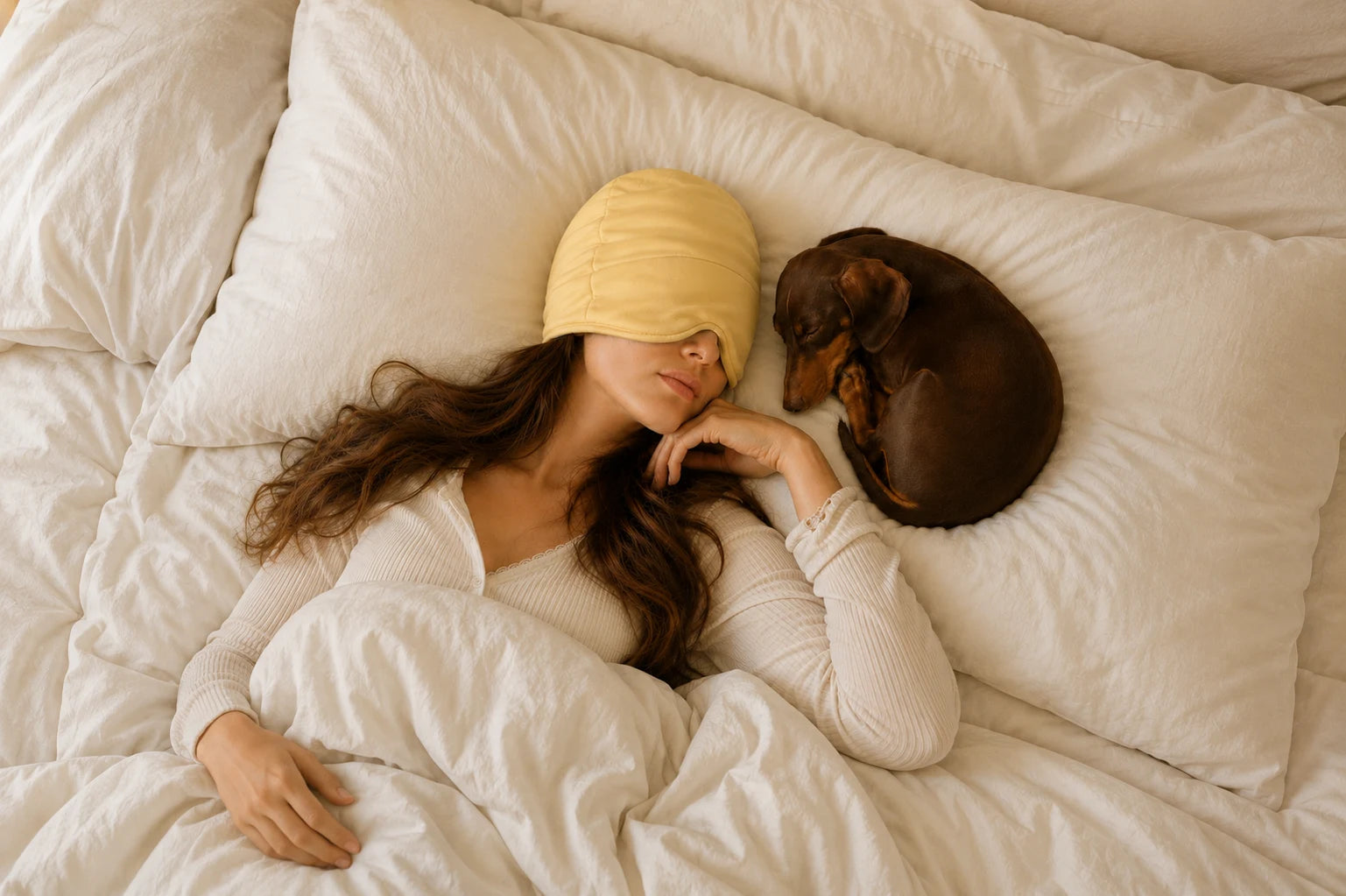
Darkness is often treated like a mood.
A dark room feels calmer. A dim lamp feels softer. Blackout curtains feel more luxurious than practical. But darkness is not only atmosphere. It is information.
Light tells the body something about time. That is why screens, hallway light, streetlights, early sunrise, and small gaps around a sleep mask can matter more than they seem.
The eye does more than see images
Most of us think of the eye as a camera: it sees objects, faces, color, and movement. But the eye also helps send light-dark information to the body's circadian system.
Specialized retinal cells called intrinsically photosensitive retinal ganglion cells, or ipRGCs, contain melanopsin and are involved in non-image-forming responses to light. In simpler terms: some light sensing is not about seeing a picture. It is about helping the body understand the environment.
You may not be staring at the hallway light. Your body can still register that the room is not fully dark.
Why "mostly dark" may not feel dark enough
For many people, a mostly dark room is fine. For others, small light leaks can feel disruptive. Common sources include:
- light under the door
- LEDs from chargers or devices
- streetlight through curtains
- early morning brightness
- a partner's phone
- gaps around a standard eye mask
If you are light-sensitive, darkness may need to be designed more completely. That does not mean the room has to feel severe or cave-like. It means the sleep environment should stop sending unnecessary light signals.
Darkness is also emotional
Darkness works on more than one level. It may support circadian timing, but it can also create privacy. A darker space can feel less exposed, less available, and less mentally open to the day.
That is why blackout is not only a technical feature. It is part of how a product changes the feeling of a room.
For Beside, darkness is one piece of the physical side of rest. Alongside pressure, texture, temperature, and support, it helps create conditions where the body has less to manage.
How to make your sleep environment darker
Start with the biggest light sources first:
- Reduce window light with curtains or shades.
- Cover or remove small LEDs.
- Keep phones face-down or away from the bed.
- Reduce hallway light under doors if possible.
- Use a sleep mask or Sleep Hood if room-level darkness is hard to control.
The right solution depends on your room and your body. Some people only need darker curtains. Others need coverage close to the face because shared bedrooms, travel, shift work, or early morning light make room-level darkness difficult.
That is where a product like Sleep Hood can be useful: not only blocking light directly over the eyes, but also helping reduce light from the sides and creating a more complete boundary around the head area.
That matters because light is rarely only straight ahead. It comes from angles. It changes through the night. It enters through small gaps.
Better darkness is not about making rest dramatic. It is about making the environment clearer: less light, fewer signals, less to process.